

Travel Information
The information below is provided as general guidance only, and delegates should always consult official Australian Government sources for the most up to date requirements before travelling. Please visit the Australian Governments Department of Home Affairs Immigration website for correct and up to date information. You may find the type of visa you required for APVRS Congress at https://immi.homeaffairs.gov.au/visas/getting-a-visa/visa-finder.
Australia requires all foreign nationals (except New Zealand passport holders) to hold a valid visa before entering the country.
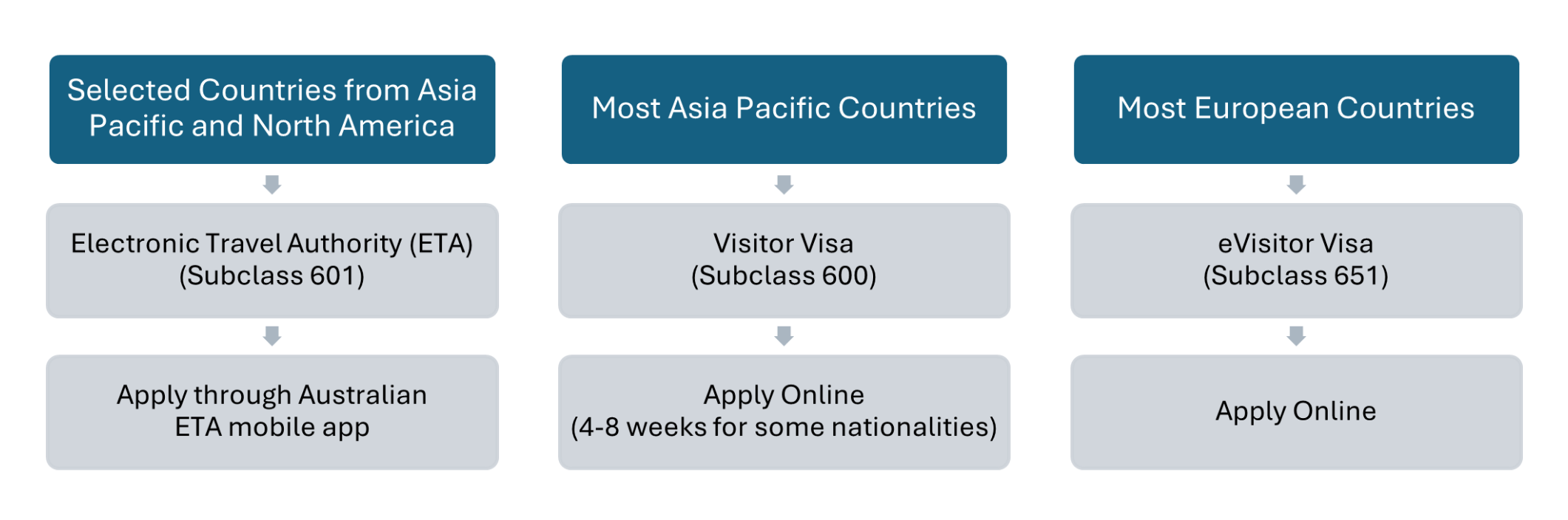
Electronic Travel Authority (ETA – Subclass 601)
For passport holders from: Singapore, Japan, South Korea, USA, Canada and other selected countries.
ETA applications are submitted exclusively through the Australian ETA mobile app (iOS & Android).
A small service fee applies.
Official info:
https://immi.homeaffairs.gov.au/visas/getting-a-visa/visa-listing/electronic-travel-authority-601
Visitor Visa (Subclass 600) – Most Common for APVRS Delegates
The Visitor Visa (600) is available to almost all nationalities and is the primary pathway for APVRS attendees from Asia-Pacific countries.
The visa allows attendance at business events and conferences such as APVRS.
What delegates will need:
- Passport valid for at least 6 months
- Completed online application
- Evidence of sufficient funds
- Return/onward travel booking
- Congress registration confirmation email
- Accommodation booking or invitation letter (if required)
Processing times vary significantly, so early application is strongly recommended (4-8 weeks for some nationalities).
Official info:
https://immi.homeaffairs.gov.au/visas/getting-a-visa/visa-listing/visitor-600
eVisitor Visa (Subclass 651)
Fee: Free
Processing: Usually fast, but times vary between countries.
Eligible passport holders include: European Union countries, United Kingdom and Several nonEU European countries (e.g., Norway, Switzerland, Iceland)
Official info:
https://immi.homeaffairs.gov.au/visas/getting-a-visa/visa-listing/evisitor-651
Other Visa Pathways
Delegates with additional professional activities (e.g., speaking engagements, meetings beyond the Congress, extended stay) may consider:
- Business Visitor stream (Visitor 600)
- Frequent Traveller stream (Visitor 600)
- Work / Temporary Activity Visa (Subclass 408) for certain specialised activities
For most APVRS delegates, Visitor (600) is appropriate.
Full visa list:
https://immi.homeaffairs.gov.au/visas/getting-a-visa/visa-finder
Vaccination Requirements
Australia currently has no routine vaccination requirements for entry for most travellers.
COVID19
- No testing, vaccination, or quarantine required.
Yellow Fever
A valid Yellow Fever Vaccination Certificate is required only if you have travelled through or transited a country with yellow fever risk within the previous 6 days.
List of yellow fever risk countries (WHO):
https://www.who.int/health-topics/yellow-fever
Recommended Travel Vaccinations
(Not mandatory, but commonly advised)
- Measles-Mumps-Rubella (MMR)
- Seasonal influenza
- Tetanus
- Hepatitis A/B depending on individual risk
Travellers should consult their doctor or local travel clinic before departure.
Customs, Biosecurity & Bringing Items into Australia
Australia has some of the strictest customs and biosecurity laws in the world, and all travellers must declare any food, plant material, animal products, wooden items, traditional medicines, or goods that may carry soil or biological matter. Even small quantities of snacks, tea, seeds, dried fruit, herbal products, or cultural items may be restricted. Failure to declare items — even if they are permitted — can result in on the spot fines or more serious penalties. Upon arrival, you will complete a digital or paper Incoming Passenger Card where all goods must be declared honestly. If you are unsure, simply declare your item; biosecurity officers will advise if it is allowed. Full guidance, including permitted and prohibited goods, is available from the Australian Border Force (ABF) and the Department of Agriculture, Fisheries and Forestry (DAFF). Delegates are strongly encouraged to review these resources before packing.
Official information:
- Australian Border Force (Customs): https://www.abf.gov.au
- Biosecurity requirements (DAFF): https://www.agriculture.gov.au/biosecurity-trade/travelling
Useful Information about Australia and the Gold Coast
Weather
August on the Gold Coast falls in the Australian winter, bringing mild, dry, and very comfortable conditions for visitors. Daytime temperatures typically range from 20-24°C, while evenings can cool down to 10-14°C. Rainfall is low during this time of year, and humidity levels are much lower than in summer. Layers are recommended during the day, with a warmer jacket or jumper for early mornings and evenings, especially if visiting from a tropical region or the northern hemisphere.
Time Zone
The Gold Coast operates on Australian Eastern Standard Time (AEST), UTC +10 in August (no daylight savings at this time of year). Please check time differences when arranging international flights or virtual meetings.
Currency
The official currency is the Australian Dollar (AUD).
Credit and debit cards are widely accepted, including contactless payments (Visa, Mastercard, Amex, Apple Pay, Google Pay). ATMs are common in airports, hotels, and shopping areas.
Electrical Power / Plug Socket
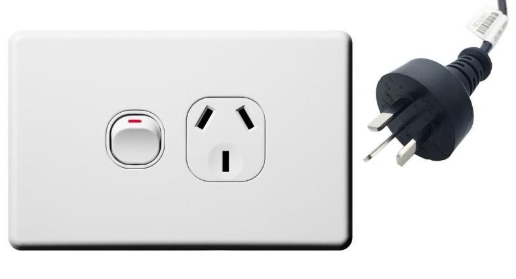
Australia uses Type I power plugs:
- Voltage: 230V
- Frequency: 50Hz
Travellers from regions using different plug types will need a suitable adapter.
Internet Access
Highspeed internet is available across the Gold Coast.
- GCCEC and most hotels provide complimentary WiFi
- Cafés, shopping centres, and airports commonly offer WiFi access
- Prepaid SIMs and eSIMs (Telstra, Optus, Vodafone) can be purchased at airports or convenience stores
Tipping
Tipping is not compulsory and often discouraged in Australia. However, in cases of excellent service: rounding up your bill or leaving a few dollars in acknowledgement is appreciated.
Smoking
Smoking and vaping are prohibited in all indoor public places, at transport hubs, and in many outdoor dining areas. Designated smoking areas are clearly marked. Fines may apply for smoking outside permitted zones.
Spitting
Spitting in public is strongly discouraged and may attract penalties in some areas. Delegates are asked to respect local expectations regarding public cleanliness.
Drinking Water
Tap water in Australia is safe to drink and of high quality. Filtered water stations are widely available at airports, hotels, beaches, and the convention centre.
Safety
The Gold Coast is considered a safe city for visitors. Standard precautions apply:
- Keep personal belongings secure in busy areas
- Use pedestrian crossings and follow local road rules
- At the beach, swim between the red and yellow flags at patrolled locations, as surf conditions can be strong
For emergencies, dial 000 for police, fire, or ambulance.
Travel Insurance
All international visitors are strongly encouraged to arrange comprehensive travel insurance covering:
- Medical care (which can be expensive for nonresidents)
- Lost or damaged luggage
- Delays or cancellations
- Personal liability
Tax Refund (TRS – Tourist Refund Scheme)
International travellers may be eligible to claim a refund of the Goods and Services Tax (GST) for purchases over AUD $300 made within 60 days of departure. Claims are processed at major airports before leaving Australia.
Full details:
https://www.abf.gov.au/entering-and-leaving-australia/tourist-refund-scheme